
Ci sono oggetti che non appartengono soltanto al passato, ma alla nostra immaginazione più profonda. Oggetti che, anche quando tacciono, continuano a parlare. Il trono è uno di questi: un seggio che non è mai stato solo un posto dove sedersi, ma un luogo mentale, un’idea, un racconto collettivo. Ogni civiltà ne ha costruito uno, reale o simbolico, per dare forma visibile al potere, per renderlo comprensibile, per trasformarlo in un’immagine capace di attraversare i secoli.
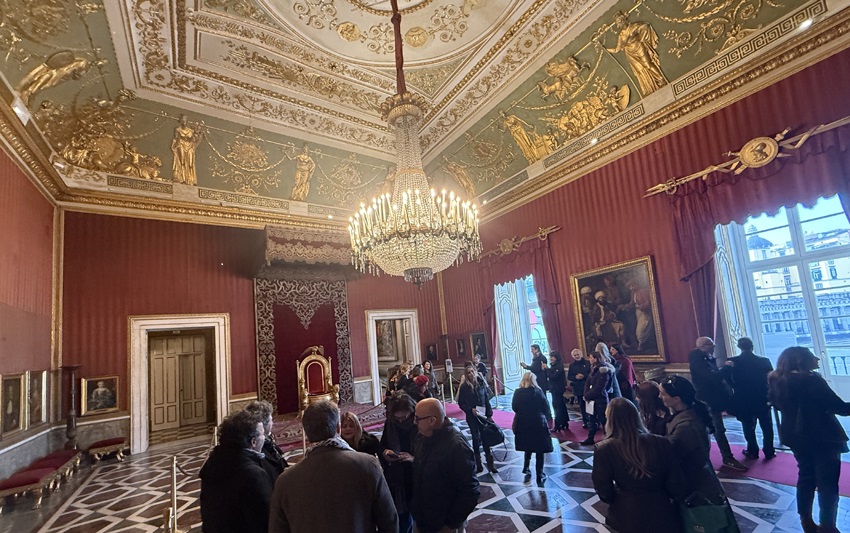
Eppure, quando un trono torna a mostrarsi dopo un periodo di silenzio, non è soltanto la storia a riemergere: siamo noi a ritrovarci davanti a ciò che abbiamo creduto, temuto, desiderato. È un incontro tra ciò che eravamo e ciò che siamo diventati. È questo il sentimento che accoglie oggi il visitatore che entra nella sala del trono di Palazzo Reale di Napoli, dove il trono, restaurato con cura quasi rituale, torna a brillare come un frammento di memoria restituito alla luce.
Nella storia delle civiltà, il trono è sempre stato molto più di un oggetto. È un luogo simbolico, un punto di convergenza tra autorità e immaginario collettivo. Attorno a esso si sono costruite narrazioni di potere, rituali, gerarchie. Il trono non rappresentava solo chi vi sedeva, ma l’idea stessa di ordine, di stabilità, di continuità. Per questo, quando un trono ritorna alla sua forma originaria, non è soltanto un mobile restaurato: è un frammento di memoria che riaffiora, un’occasione per interrogare il passato e, allo stesso tempo, il presente.
È ciò che accade oggi a Palazzo Reale di Napoli, dove il trono — dopo un lungo e accurato intervento di restauro — torna a mostrarsi nella sua rinnovata magnificenza. Le dorature, ripulite con pazienza millimetrica, hanno recuperato una luminosità che sembrava perduta; il velluto ha ritrovato profondità e consistenza; gli intagli lignei, liberati dalle ossidazioni, rivelano dettagli che raccontano la maestria degli artigiani dell’epoca.
IERI E OGGI
Quando i Savoia si insediarono nel Palazzo Reale di Napoli, dopo la caduta dei Borbone, trovarono una reggia splendida ma segnata dal tempo. La sala del trono, cuore dell’Appartamento di Etichetta, appariva ormai inadatta alla nuova corte. Si decise così di venderne i vecchi arredi e avviare un grande progetto di rinnovamento.
La sedia del trono borbonica, pur imponente, non convinse. Nel 1873 venne fatto arrivare da Palermo il trono più grande conservato nel Guardamobili reale, ma una volta montato provvisoriamente ci si rese conto che non bastava: occorreva qualcosa di più maestoso, più moderno, più degno della nuova dinastia.
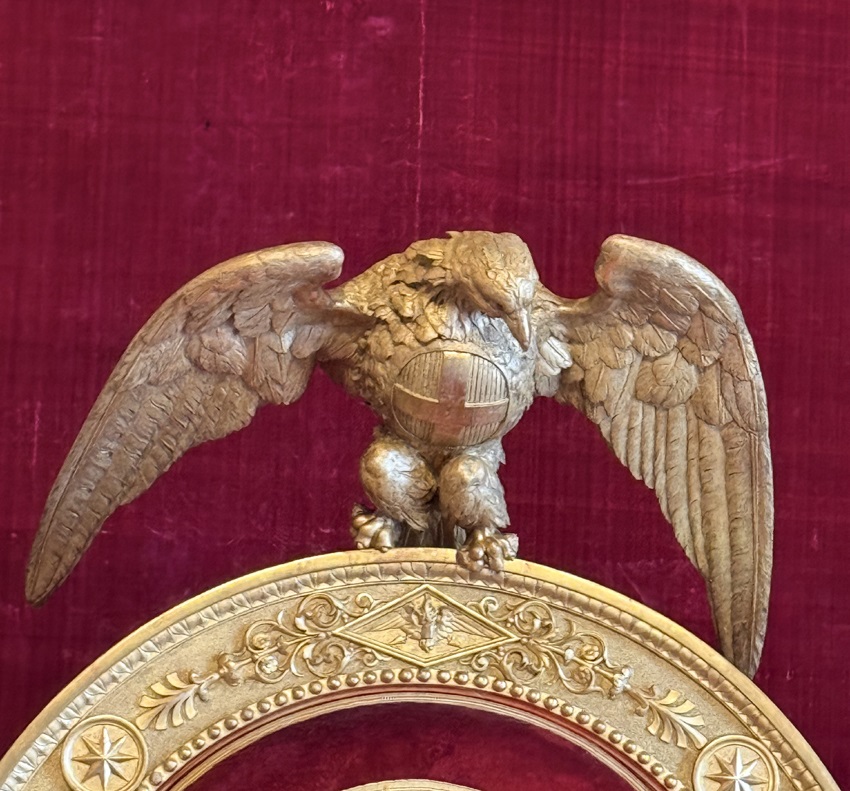
La scelta di realizzare il nuovo trono cadde su Luigi Ottajano, raffinato intagliatore napoletano, già autore — insieme a Domenico Morelli — della culla per la nascita di Vittorio Emanuele III, donata dalla città di Napoli alla regina Margherita e oggi esposta alla Reggia di Caserta. A lui fu affidata la creazione di una nuova sedia regale in stile Impero e di un grande coronamento con l’aquila sabauda, simbolo della contea di Moriana. Il suo lavoro non si limitò al trono: realizzò sovrapporte, zinefre, sgabelli, cornici dorate per decine di metri e restaurò la volta della sala. Nel giugno 1874 l’intero allestimento era completato.
Dopo la prima guerra mondiale il palazzo visse anni di silenzio, finché negli anni Trenta, con l’arrivo del principe di Piemonte, tornò a risplendere. Anche la sala del trono venne aggiornata: nuove tappezzerie, un baldacchino che finirà persino al Quirinale, dove farà da sfondo all’incoronazione di Vittorio Emanuele III come re d’Albania nel 1939. Solo nel dopoguerra tornerà a Napoli.
Un documento ritrovato di recente nell’Archivio di Stato — la fattura di Ottajano del 1874 — ha permesso di chiarire definitivamente l’origine sabauda del trono, spesso attribuito invece alla tarda epoca borbonica. Finora si pensava che l’artigiano avesse aggiunto solo l’aquila; in realtà l’intero trono è opera sua.
I restauri più recenti della sala hanno rivelato quanto il tempo e gli interventi successivi avessero compromesso il manufatto: materiali eterogenei, alterazioni, depositi superficiali. Da qui la necessità di un nuovo restauro, fondamentale per restituire al trono la sua dignità storica e artistica.
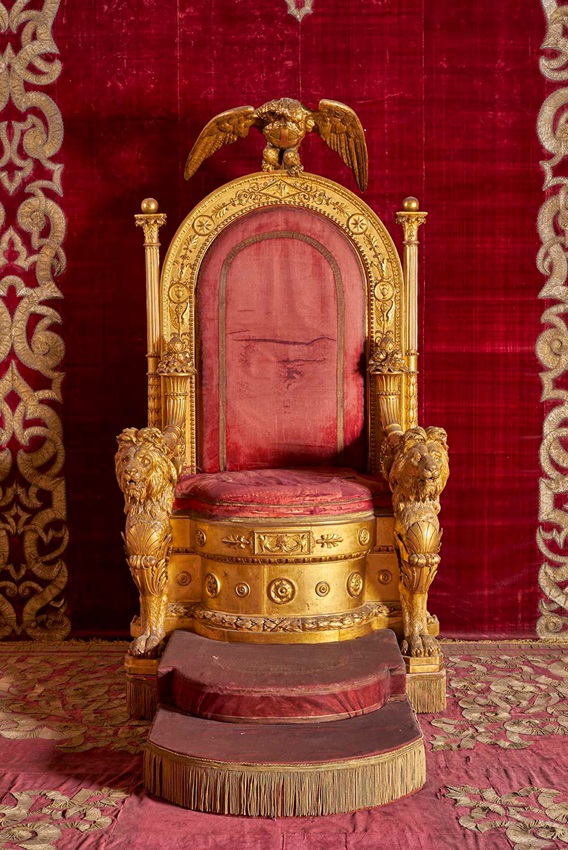
L’intervento conservativo, realizzato grazie al progetto Restituzioni di Intesa Sanpaolo ed eseguito dalla Fondazione Centro per la Conservazione e il Restauro dei Beni Culturali “La Venaria Reale”, ha coinvolto il laboratorio di arredi lignei e quello manufatti tessili.
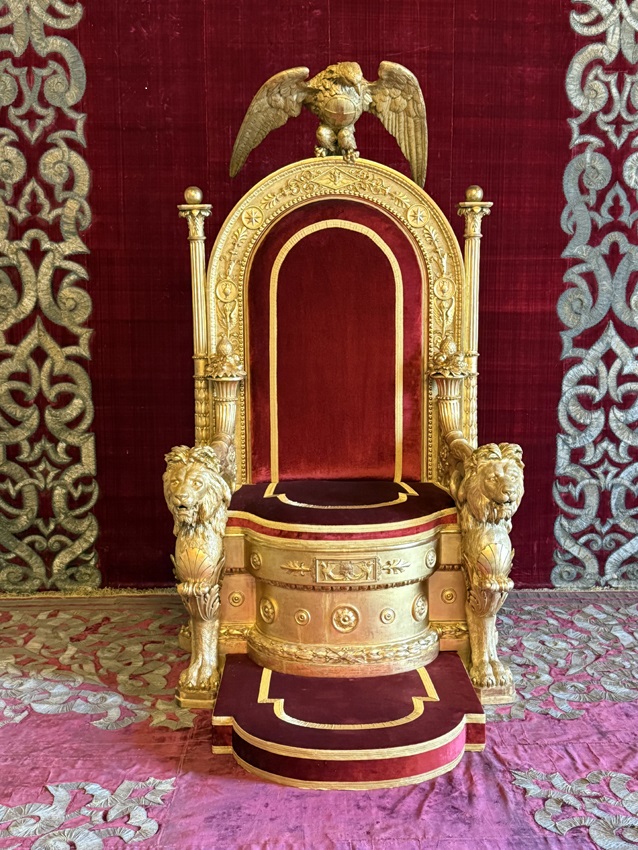
Progettato sulla base delle indagini diagnostiche, l’intervento ha permesso di restituire lo straordinario trono pienamente restaurato nella sua complessa struttura lignea scolpita e dorata, nonché rinnovato nelle componenti tessili e nella passamaneria. Attraverso la tecnologia laser è stata effettuata una parte significativa della pulitura superficiale, recuperando la luminosità della doratura e riducendo l’uso di solventi e materiali chimici. Il rivestimento tessile è stato sostituito integralmente a causa del degrado delle fibre.
In attesa di riallestire tutte le sale dell’Appartamento di Etichetta e di restaurare opere e arredi lungo il percorso — così da far tornare Palazzo Reale allo splendore borbonico e sabaudo, rievocando il fasto degli ultimi sovrani che vi hanno vissuto — ci si è preparati ad accogliere il trono. Sono stati restaurati il tappeto su cui poggia la seduta regale, le fasce laterali che ricoprono la pedana, le mantovane delle tende della sala, oltre a un accurato “spolvero” del baldacchino.
Il trono aveva lasciato la sala il 12 settembre 2024 per raggiungere il centro Conservazione e Restauro di Torino. A conclusione dei lavori, durati sette mesi, nel maggio successivo è stato esposto alla Reggia di Venaria, prima di diventare uno dei protagonisti della XX edizione della mostra Restituzioni, tenutasi al Palazzo delle Esposizioni di Roma dal 28 ottobre 2025 al 18 gennaio 2026. Ora il simbolo della reggia è rientrato al suo posto e, con la magnificenza delle sue sculture e il suo splendore, torna a suggellare l’atmosfera regale del Palazzo.
QUEI LEONI ALATI
Il trono, con sedile a tamburo, presenta braccioli decorati da leoni alati di grande effetto scultoreo. Nella parte anteriore i leoni terminano sul gradino inferiore con zampe monopodi, mentre posteriormente si dipartono due cornucopie — simbolo di abbondanza del regno e della Campania Felix — che si ricongiungono allo schienale. Ai lati dello schienale si trovano due colonne scanalate che conferiscono maggiore slancio alla seduta, posta su una pedana a doppio gradino.
Il gradino su cui poggia il trono è semicircolare e insiste su un altro gradino semicircolare, in origine di forma quadrangolare. La pedana fu sostituita nel 1915 con una nuova in velluto di seta con riquadratura in gallone dorato, come chiarisce un documento dell’Archivio Centrale dello Stato.
Situato in posizione elevata nella sala del trono o sala delle udienze, il seggio personificava l’autorità del sovrano e, per estensione, la stabilità del regno. L’elevazione su pedana e la copertura con baldacchino manifestavano visivamente la natura sacra e sovrana del monarca, separandolo dal piano terreno dei sudditi. La pedana serviva anche a rendere il sovrano fisicamente più alto di chiunque altro nella stanza, simbolo della sua superiorità gerarchica e della sua vicinanza al divino.
SPECCHIO DEL POTERE
«Restaurare un trono significa restituire voce a un oggetto che ha assistito a secoli di storia», ha ricordato una volta una grande restauratrice. «Non si tratta solo di riportare alla luce l’oro o il colore, ma di capire come il tempo ha dialogato con la materia, e come noi possiamo inserirci in quel dialogo senza interromperlo».
Il trono, ricollocato nella sua sala, torna così a occupare il proprio posto naturale, ma lo fa in un contesto profondamente mutato. Se un tempo era il fulcro di un potere verticale, oggi diventa un oggetto da osservare, interpretare, comprendere. Il visitatore non si trova più davanti a un simbolo di autorità indiscutibile, ma a un testimone silenzioso di un’epoca in cui il potere si manifestava attraverso la magnificenza e la distanza.
Lo storico dell’arte Giovanni Rinaldi sottolinea questo cambiamento: «Oggi il potere non si rappresenta più attraverso la monumentalità, ma attraverso la comunicazione, la velocità, la visibilità digitale. Il trono restaurato ci ricorda che un tempo il potere aveva bisogno di essere visto, toccato, messo in scena. Oggi, invece, è spesso invisibile, diffuso, frammentato».
Il ritorno del trono non è solo un evento museale: è un invito a riflettere su come cambiano i simboli e su come cambiamo noi. In un’epoca in cui il potere non siede più su un trono, ma scorre attraverso reti, algoritmi, decisioni collettive e dinamiche globali, questo oggetto antico ci ricorda che ogni società ha bisogno di rappresentarsi, di dare forma visibile alle proprie idee di autorità e di comunità.
Il trono restaurato non ci parla di nostalgia, ma di consapevolezza. Ricorda che il passato non è un luogo da imitare, ma un serbatoio di significati da interrogare. E mentre la sua luce dorata torna a diffondersi nella sala, sembra suggerire che anche ciò che credevamo immobile può rinascere, trasformarsi, trovare nuovi modi per raccontare chi siamo.
L’antico simbolo del potere — il trono, emblema sacro e secolare, oggetto che nell’immaginario collettivo, attraverso materiali preziosi e decorazioni simboliche, comunicava autorità, rettitudine legale e sapienza — oggi è sostituito da un’immagine meno rassicurante, meno definita e priva di regole. Un potere che si basa sulla forza e che spesso non mostra alcun rispetto per la vita delle persone.
Alla presentazione in conferenza stampa sono intervenuti: la direttrice delegata Tiziana D’Angelo, la direttrice dei Laboratori del Centro Conservazione e Restauro La Venaria Reale Michela Cardinali, l’ex direttrice ad interim del Palazzo Reale di Napoli e attuale Soprintendente ABAP per l’Area Metropolitana di Napoli Paola Ricciardi, e il vicedirettore delle Gallerie d’Italia di Napoli Antonio Denunzio, in rappresentanza di Intesa Sanpaolo.
Il dottor Denunzio ha raccontato che, negli anni in cui è stato a Palazzo Reale, una persona veniva spesso nella reggia, si fermava nella sala del trono e aspettava: voleva incontrare e parlare con il re. Ho immaginato quella figura in attesa. Ha il volto di tutti coloro che cercano un punto di riferimento su cui contare per dissipare le nebbie fitte che avvolgono le vite personali e sconvolgono quelle collettive, di sicuro più complesse e articolate.
©Riproduzione riservata
Per saperne di più
Learn more
https://palazzorealedinapoli.org/
Royal Palace/ Naples, the throne returns after restoration. Symbol of an evolving power: when time interacts with material
There are objects that belong not only to the past, but to our deepest imagination. Objects that, even when silent, continue to speak. The throne is one of these: a seat that has never been merely a place to sit, but a mental space, an idea, a collective narrative. Every civilization has constructed one—real or symbolic—to give visible form to power, to make it comprehensible, to transform it into an image capable of crossing centuries.
Yet when a throne reappears after a period of silence, it is not only history that resurfaces: it is we ourselves who stand once more before what we have believed in, feared, desired. It is an encounter between who we were and who we have become. This is the feeling that welcomes visitors today as they enter the Throne Room of the Royal Palace of Naples, where the throne, restored with almost ritual care, shines again like a fragment of memory returned to the light.
Throughout the history of civilizations, the throne has always been far more than an object. It is a symbolic place, a point of convergence between authority and the collective imagination. Around it were constructed narratives of power, rituals, hierarchies. The throne represented not only the one who sat upon it, but the very idea of order, stability, and continuity. For this reason, when a throne returns to its original form, it is not merely a restored piece of furniture: it is a fragment of memory resurfacing, an opportunity to question the past and, at the same time, the present.
This is what is happening today at the Royal Palace of Naples, where the throne—after a long and meticulous restoration—now reappears in renewed magnificence. The gilding, cleaned with millimetric patience, has regained a luminosity that seemed lost; the velvet has recovered depth and substance; the carved wooden elements, freed from oxidation, reveal details that testify to the mastery of the craftsmen of the time.
YESTERDAY AND TODAY
When the House of Savoy settled in the Royal Palace of Naples after the fall of the Bourbons, they found a splendid residence marked by time. The Throne Room, the heart of the State Apartment, appeared no longer suitable for the new court. It was therefore decided to sell the old furnishings and begin an ambitious renovation project.
The Bourbon throne chair, though imposing, did not convince. In 1873, the largest throne preserved in the royal furnishings repository was brought from Palermo, but once provisionally assembled it was deemed insufficient: something more majestic, more modern, more worthy of the new dynasty was required.
The commission for the new throne was entrusted to Luigi Ottajano, a refined Neapolitan woodcarver, already known—together with Domenico Morelli—for creating the cradle for the birth of Vittorio Emanuele III, donated by the city of Naples to Queen Margherita and now displayed at the Royal Palace of Caserta. He was tasked with creating a new royal seat in Empire style and a grand crowning element with the Savoyard eagle, symbol of the County of Moriana. His work extended beyond the throne: he created overdoors, decorative elements, stools, gilded frames stretching dozens of meters, and restored the vaulted ceiling of the hall. By June 1874, the entire installation was completed.
After the First World War, the palace entered years of silence, until in the 1930s, with the arrival of the Prince of Piedmont, it regained splendor. The Throne Room was updated: new tapestries were installed, and a canopy—later transferred to the Quirinal Palace—served as the backdrop for the coronation of Vittorio Emanuele III as King of Albania in 1939. Only after the Second World War did it return to Naples.
A document recently rediscovered in the State Archives — Ottajano’s 1874 invoice — definitively clarified the Savoy origin of the throne, often mistakenly attributed to the late Bourbon period. Until now, it was believed that the craftsman had added only the eagle; in reality, the entire throne is his work.
Recent restorations of the room revealed how time and later interventions had compromised the artifact: heterogeneous materials, alterations, surface deposits. This made a new restoration necessary to restore the throne’s historical and artistic dignity.
The conservation intervention, carried out thanks to the “Restituzioni” project of Intesa Sanpaolo and executed by the Foundation Center for Conservation and Restoration of Cultural Heritage “La Venaria Reale,” involved both the Wooden Furnishings Laboratory and the Textile Artifacts Laboratory.
Based on diagnostic investigations, the restoration returned the throne fully restored in its complex carved and gilded wooden structure, as well as renewed in its textile components and trimmings. Laser technology was used for a significant part of the surface cleaning, recovering the brilliance of the gilding while reducing the use of solvents and chemicals. The textile covering was entirely replaced due to fiber degradation.
While awaiting the complete reinstallation of all the rooms of the State Apartment and the restoration of artworks and furnishings along the route—so that the Royal Palace may once again evoke its Bourbon and Savoy splendor, recalling the grandeur of the last sovereigns who lived there—the palace prepared to welcome the throne. The carpet on which the royal seat rests, the side bands covering the platform, the curtain valances, and the canopy were also carefully restored and dusted.
The throne left the room on the 12th of Sptember 2024, to reach the Conservation and Restoration Center in Turin. After seven months of work, it was exhibited at the Reggia di Venaria in May, before becoming one of the protagonists of the twentieth edition of the “Restituzioni” exhibition, held at the Palazzo delle Esposizioni in Rome from the 28th of October 2025 to the 18th of January 2026. Now the symbol of the palace has returned to its place and, with the magnificence of its sculptures and its splendor, once again seals the royal atmosphere of the Palace.
THOSE WINGED LIONS
The throne, with its drum-shaped seat, features armrests decorated with winged lions of remarkable sculptural impact. At the front, the lions end on the lower step with monopod paws, while at the back two cornucopias—symbols of the abundance of the kingdom and of Campania Felix—extend and reconnect to the backrest. On either side of the backrest stand two fluted columns that lend greater vertical momentum to the seat, positioned on a double-stepped platform.
The step on which the throne rests is semicircular and stands upon another semicircular step, originally quadrangular in form. The platform was replaced in 1915 with a new one in silk velvet with gold braid framing, as clarified by a document from the Central State Archives.
Situated in an elevated position within the Throne Room, or Audience Hall, the seat personified the authority of the sovereign and, by extension, the stability of the kingdom. The elevation on a platform and the canopy visually expressed the sacred and sovereign nature of the monarch, separating him from the earthly plane of his subjects. The platform also made the sovereign physically taller than anyone else in the room, symbolizing his hierarchical superiority and closeness to the divine.
MIRROR OF POWER
“Restoring a throne means giving voice back to an object that has witnessed centuries of history,” a great restorer once recalled. “It is not merely about bringing gold or color back to light, but about understanding how time has dialogued with matter—and how we can enter that dialogue without interrupting it.”
Reinstalled in the Throne Room, the throne returns to its natural place, but in a profoundly changed context. If once it was the focal point of vertical power, today it becomes an object to observe, interpret, and understand. Visitors no longer stand before an unquestionable symbol of authority, but before a silent witness to an era in which power manifested itself through magnificence and distance.
Art historian Giovanni Rinaldi emphasizes this transformation: “Today power no longer represents itself through monumentality, but through communication, speed, digital visibility. The restored throne reminds us that power once needed to be seen, touched, staged. Today, instead, it is often invisible, diffuse, fragmented.”
The return of the throne is not merely a museum event: it is an invitation to reflect on how symbols change—and how we change with them. In an age in which power no longer sits on a throne but flows through networks, algorithms, collective decisions, and global dynamics, this ancient object reminds us that every society needs to represent itself, to give visible form to its ideas of authority and community.
The restored throne does not speak of nostalgia, but of awareness. It reminds us that the past is not a place to imitate, but a reservoir of meanings to be questioned. And as its golden light once again spreads through the hall, it seems to suggest that even what we believed immobile can be reborn, transformed, and find new ways to tell us who we are.
The ancient symbol of power—the throne, sacred and secular emblem, an object that in the collective imagination, through precious materials and symbolic decorations, communicated authority, legal rectitude, and wisdom—is today replaced by a less reassuring, less defined image, lacking rules. A power based on force, often showing no respect for human life.
At the press conference presentation were: Managing Director Tiziana D’Angelo; Michela Cardinali, Director of the Laboratories of the Center for Conservation and Restoration La Venaria Reale; Paola Ricciardi, former Interim Director of the Royal Palace of Naples and current Superintendent ABAP for the Metropolitan Area of Naples; and Antonio Denunzio, Deputy Director of the Gallerie d’Italia in Naples, representing Intesa Sanpaolo.
Dr. Denunzio recounted that during his years at the Royal Palace, a person would often come to the palace, stop in the Throne Room, and wait: he wanted to meet and speak with the king. I imagined that figure waiting. He bears the face of all those who seek a point of reference to rely on, to dispel the thick fog that envelops personal lives and unsettles collective ones—certainly more complex and articulated.