
Un’artista che ha saputo conquistare un posto centrale nella storia dell’arte contemporanea internazionale. Oltre i confini della sua isola, la Sardegna. Maria Lai (1929 – 2013) ha intrecciato dialoghi al di là del tempo, costruendo ponti creativi indistruttibili. Per farlo ha utilizzato fili, inventato fiabe, disegnato narrazioni radicate ancora nell’oggi. E questa sua vicenda artistica adesso è in mostra al terzo piano del Museo Madre di Napoli, in via Settembrini 9, fino al 21 settembre.
E’ stata inaugurata di recente insieme a un altro progetto, esposto al secondo piano (fino al 28 settembre), generato dal Premio Meridiana, riservato a giovani talenti del Sud Italia, invitati a confrontarsi con l’opera di un artista come Jimmie Durham, legato alla città di Napoli.
Così passato e presente si incontrano per produrre stimoli interessanti che ci accompagnano nei giorni che verranno.
Dunque, la mostra Maria Lai. Essere è tessere, a cura di Mónica Amor e Carlos Basualdo, in collaborazione con l’Archivio e la Fondazione Maria Lai, accompagnata dal catalogo edito da Lenz Press, conduce il pubblico sul cammino di una paziente ricerca materica, formale e concettuale, partendo dalla memoria e dalle sue mutazioni.
Un percorso che corre lungo il filo cronologico e si apre con le prime opere dell’artista riconducibili al territorio e successivamente al suo inserimento nell’avanguardia del panorama artistico internazionale.
Un posto centrale in questo excursus, l’esposizione alla Galleria Schneider di Roma (1971, curata dal critico Marcello Venturoli) dove Lai inaugura i Telai che scardinano il supporto pittorico e la cornice: corde, legno, chiodi e pigmenti senza cancellare elementi come il sole, il mare e il paesaggio.
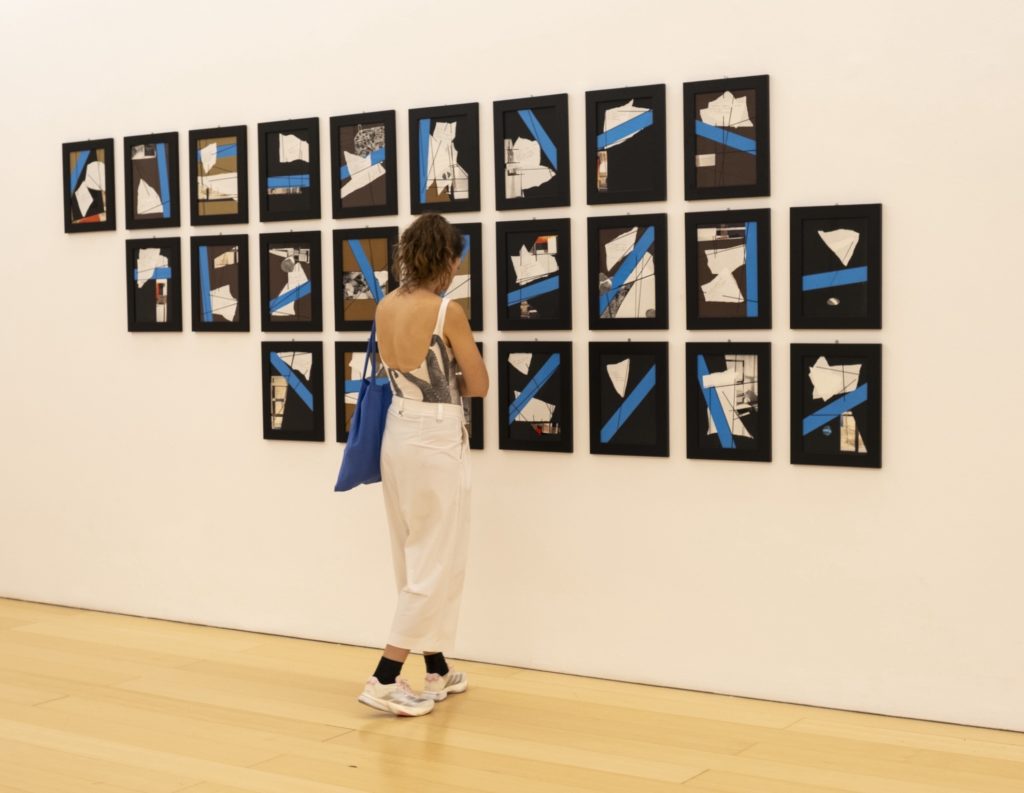
E’ una questione di pensiero quella che spinge genialità e perseveranza sui sentieri di Tele cucite (1974–1976), di Libri Cuciti (iniziati nel 1978 e sviluppati negli anni ’80) di Geografie (iniziate intorno al 1981) che uniscono tessuto e cucito in una prospettiva cosmica.
Suggestivo lo spazio che raccoglie le colorate Fiabe cucite (1984–2005), realizzate con materiali e tecniche che le donne del suo paese padroneggiavano fin dall’infanzia: rimandano a antichi rituali di una vita sempre carica di mistero.
Ad accomunare Maria Lai a Napoli è la capacità dell’artista di amare l’esplosione di colori espressa nel paesaggio di un luogo dove tenebre e luce convivono in un pittoresco abbraccio.
Lo stesso che attraversa la mostra del Premio Meridiana, Living Collapse, a cura di Samuele Piazza, che presenta opere degli artisti Andrea Bolognino (Napoli, 1991), Effe Minelli (Pompei, 1986) e Raffaela Naldi Rossano (Napoli, 1990).
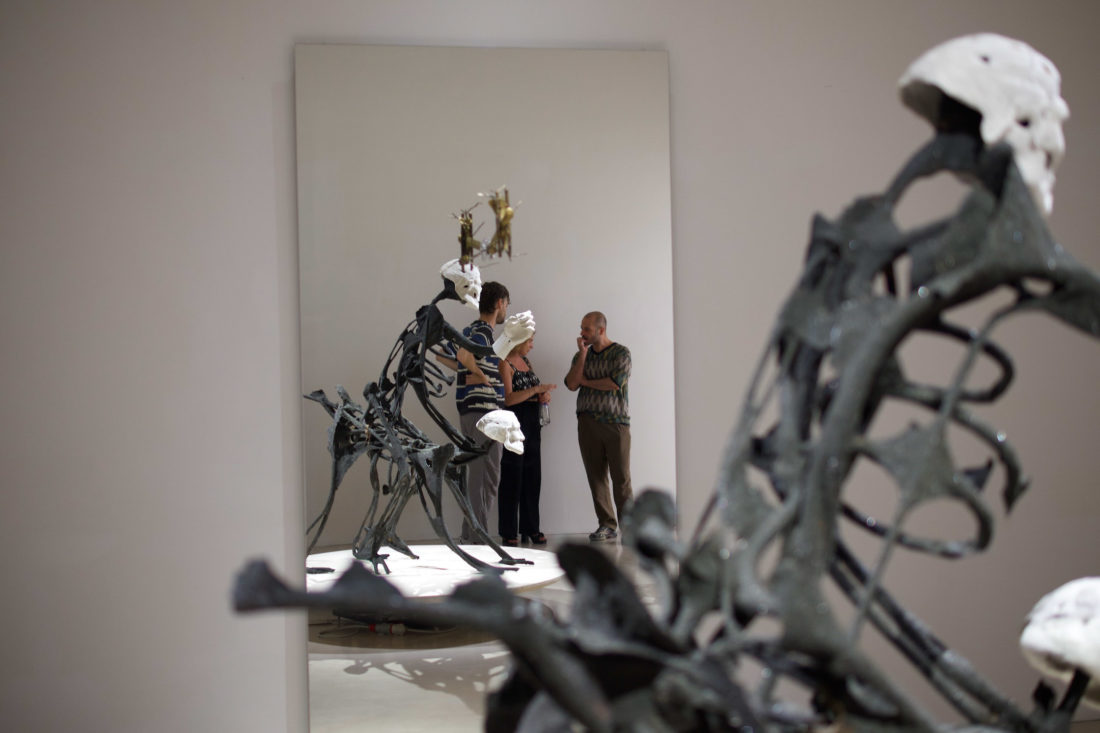
La mostra parte da un elemento della tradizione quale il presepe napoletano e si tuffa in metamorfosi visiva che diventa ammaliante e giocoso incastro archeologico nella scultura di cartapesta e ceramica firmata da Effe Minelli (con formazione accademica mitteleuropea): la morte in bianco e nero cavalca due scheletri, in un ironico sberleffo alla vita.
Per saperne di più
Learn more
https://www.madrenapoli.it/
In copertina, l’installazione di Effe Minelli
Here above, works by Maria Lai on display in the third-floor gallery
On the cover, an art installation by Effe Minelli
Madre Museum / Metamorphosis of Art: Maria Lai weaves dialogues with memory. And the Meridiana Prize offers new perspectives of the imagination, beginning with tradition
An artist who has carved out a central place for herself in the history of international contemporary art, extending beyond the borders of her island, Sardinia. Maria Lai (1929–2013) has woven dialogues that transcend time, building indestructible creative bridges. To do so, she used threads, invented fairy tales and crafted narratives that remain rooted in the present day. Her artistic journey is now on display on the third floor of the Madre Museum in Naples, at 9 Via Settembrini, until 21st September.
It was recently inaugurated alongside another project, on display on the second floor (until 28 th September), stemming from the Meridiana Prize, reserved for young talents from Southern Italy, who were invited to engage with the work of an artist such as Jimmie Durham, who has close ties to the city of Naples.
Thus, past and present come together to produce fascinating insights that will accompany us in the days to come.
Thus, the exhibition *Maria Lai. To Be Is to Weave*, curated by Mónica Amor and Carlos Basualdo, in collaboration with the Maria Lai Archive and Foundation, and accompanied by a catalogue published by Lenz Press, takes the public on a journey through a patient exploration of materials, form and concept, beginning with memory and its transformations.
A journey that follows a chronological thread and opens with the artist’s early works, rooted in her local area, and subsequently traces her emergence onto the international avant-garde art scene.
A central place in this overview is occupied by the exhibition at the Schneider Gallery in Rome (1971, curated by the critic Marcello Venturoli), where Lai unveiled her *Telai* (Frames), which dismantle the pictorial support and the frame: ropes, wood, nails and pigments, without erasing elements such as the sun, the sea and the landscape.
It is a matter of thought that drives the genius and perseverance behind the ‘Stitched Canvases’ (1974–1976), the ‘Stitched Books’ (begun in 1978 and developed in the 1980s) and the ‘Geographies’ (begun around 1981), which combine fabric and stitching within a cosmic perspective.
The space housing the colourful *Fiabe cucite* (1984–2005) is particularly evocative; created using materials and techniques that the women of her village had mastered from childhood, these works evoke ancient rituals of a life ever steeped in mystery.
What Maria Lai shares with Naples is the artist’s ability to embrace the explosion of colour expressed in the landscape of a place where darkness and light coexist in a picturesque union.
The same spirit runs through the Meridiana Prize exhibition, *Living Collapse*, curated by Samuele Piazza, which presents works by the artists Andrea Bolognino (Naples, 1991), Effe Minelli (Pompeii, 1986) and Raffaela Naldi Rossano (Naples, 1990).
The exhibition takes its starting point from a traditional element – the Neapolitan nativity scene – and plunges into a visual metamorphosis that becomes a captivating and playful archaeological intersection in the papier-mâché and ceramic sculptures by Effe Minelli (who studied in Central Europe): Death, rendered in black and white, rides two skeletons, in an ironic mockery of life.
»