
«Attraverso la mia arte, voglio ricordare alle persone l’uguaglianza di tutti gli esseri umani, indipendentemente da razza, religione, nazionalità o cultura.
Non esiste un “noi” contro di loro; esiste solo un “noi”».
Shepard Fairey
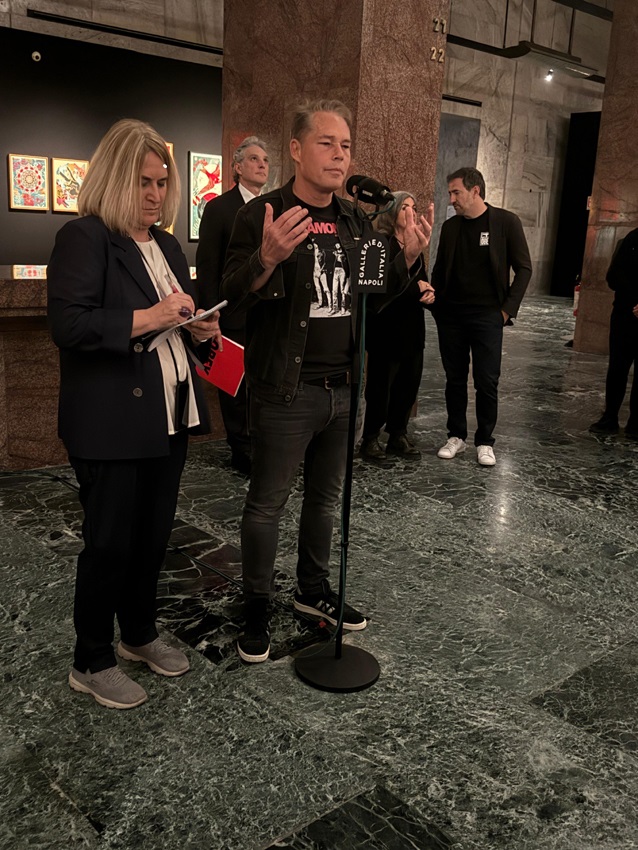
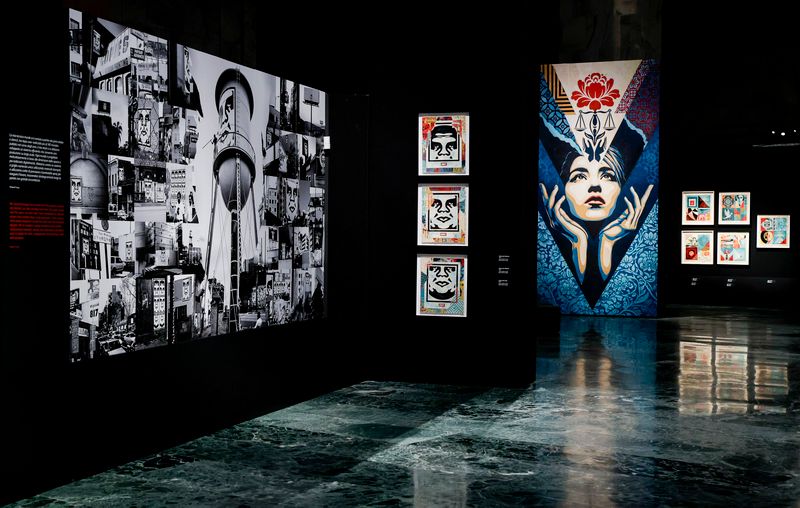
Fino al 6 settembre la mostra OBEY: Power to the peaceful alle Gallerie d’Italia Napoli. Oltre 150 opere firmate da Shepard Fairey, conosciuto a livello internazionale con il nome Obey, uno degli artisti più influenti della scena urbana contemporanea. Carmine Negro ci accompagna in questo percorso espositivo attraverso uno sguardo attento declinato in due parti.
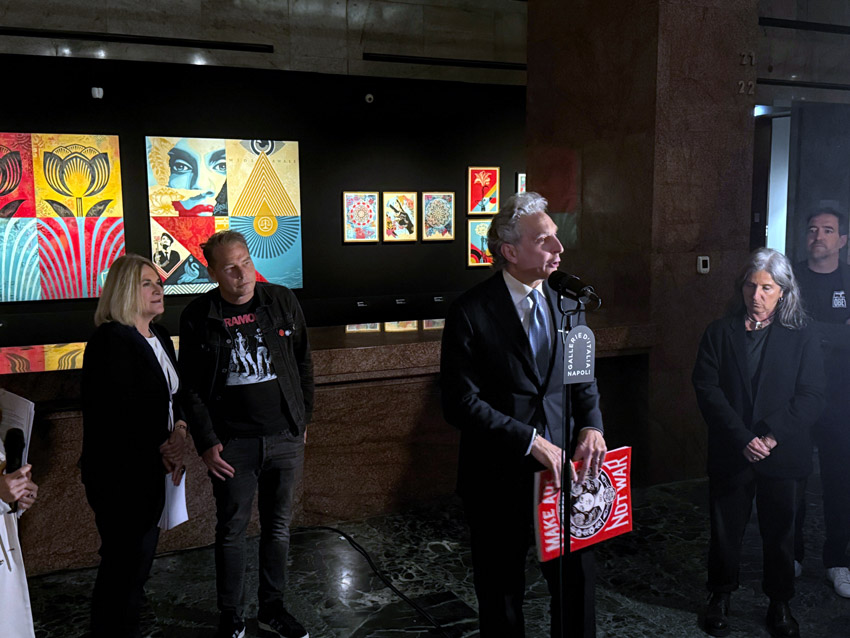
Quando i confini si irrigidiscono e le linee del potere diventano muri, l’arte può ancora aprire spiragli. Alle Gallerie d’Italia di Napoli, le opere di Shepard Fairey — il volto dietro Obey — emergono come fenditure luminose nel paesaggio del presente: immagini nate dalla strada che, una volta entrate nel museo, non perdono la loro urgenza, ma la amplificano. La loro voce, fatta di simboli netti e contrasti brucianti, non si limita a essere vista: attraversa, interroga, incrina.
Un linguaggio che seduce e poi disturba
L’arte di Fairey nasce come gesto pubblico, come intervento diretto nello spazio urbano. Manifesti, icone reiterate, slogan ribaltati costruiscono un lessico visivo che seduce lo sguardo per poi metterlo in discussione. La sua estetica, nutrita dai codici della propaganda novecentesca, non riproduce il potere: lo smonta dall’interno, trasformando ciò che era strumento di controllo in veicolo di resistenza.
Nelle sale delle Gallerie d’Italia questo linguaggio non viene neutralizzato. Al contrario, la cornice museale ne amplifica la portata critica, offrendo allo spettatore uno spazio più ampio per interrogare il ruolo dell’immagine nella costruzione del consenso e del dissenso.
Il confine come luogo di tensione
Il tema del confine attraversa l’intero percorso espositivo: confini geografici, politici, culturali, ma anche soglie meno visibili — tra arte e comunicazione, tra strada e istituzione, tra estetica e attivismo. Fairey lavora proprio su queste linee di frizione, trasformandole in superfici di attrito. Ogni opera è un varco: un punto in cui il visibile si incrina e lascia intravedere ciò che normalmente resta fuori campo.
Napoli, chiave di lettura
In questo dialogo, Napoli non è un semplice sfondo, ma una lente che amplifica il senso della mostra. Città nata quasi tremila anni fa dall’incontro di popoli diversi — greci, fenici, italici e altre comunità mediterranee, come confermato dagli studi antropologici[1] — Napoli porta nel proprio DNA una naturale avversione per ogni confine rigido, geografico o culturale. È una città meticcia per origine e vocazione, abituata a trasformare il limite in passaggio e l’alterità in convivenza.
La strada di Shepard Fairey si incrocia con quella di Napoli proprio su questo terreno. Entrambe abitano il presente dentro un’idea di comunità aperta e irriducibile, capace di accogliere senza dissolversi. Non è un caso che Goethe avvertì la stessa intensità nel suo celebre Vedi Napoli e poi muori: non un’esperienza estetica, ma esistenziale, un’esperienza che travolge e restituisce un senso di pienezza.
Anche la promiscuità sociale che caratterizza la città — che Eduardo De Filippo ha raccontato come pochi altri — rende Napoli un luogo naturalmente affine all’immaginario politico di Fairey. Qui le classi non vivono separate, ma si sfiorano, si mescolano, si osservano. L’essere prevale sull’apparire e l’immagine non è mai solo superficie, ma relazione. Per questo, alle Gallerie d’Italia, il passaggio dalla strada al museo non appare come una sottrazione, bensì come un ampliamento del discorso: l’arte urbana di Fairey non viene addomesticata, ma trova un nuovo spazio per leggere la città e, attraverso di essa, un modo diverso di guardare il mondo.
Una riflessione sul presente
La luce evocata nel titolo non è una promessa di salvezza. È una luce critica, che illumina il buio dei confini per renderlo leggibile, evidenziandone le fratture e le responsabilità. La mostra non si limita a presentare un corpus di opere, ma propone una riflessione sul nostro presente visivo, affidando allo spettatore il compito di interrogare il potere delle immagini e il ruolo dell’arte nello spazio pubblico contemporaneo.
L’esposizione nel Salone Toledo
Lo spazio che accoglie la mostra ne diventa parte integrante. Il Salone Toledo, nel cuore della città, ribadisce il legame diretto tra museo e tessuto urbano. In questa visione, il museo non è un recinto separato, ma una parte attiva della comunità: non impone consenso, ma invita alla visione critica. Guardare diventa così una forma di partecipazione. A rafforzare questa apertura è Michele Coppola, Executive director arte, cultura e beni storici di Intesa Sanpaolo: riporta la decisione di estendere la gratuità dell’ingresso dai 18 ai 25 anni, per consentire ai più giovani di frequentare il museo senza barriere né ostacoli.
Accanto al percorso museale, la mostra si estende nello spazio urbano: dal grande murale di Ponticelli all’intervento sulla scalinata di Donnaregina Nuova, fino alla donazione di un’opera destinata al Santo Padre. Ogni gesto apre un varco simbolico tra centro e periferia, tra arte e spiritualità, tra spazio pubblico e responsabilità individuale. Chi attraversa questi spazi museali resta affascinato dalla forza vitale di Napoli e contribuisce a contaminare la città, lasciando un segno della propria arte e del proprio pensiero.
La nascita di un’icona globale
Prima che il nome Obey diventasse un’icona globale, tutto ebbe inizio con un gesto minimo: un adesivo. Alla fine degli anni Ottanta, Shepard Fairey iniziò a diffondere clandestinamente l’immagine del volto imponente di André the Giant, accompagnata dalla scritta Andre the Giant Has a Posse.
Nato come esperimento visivo e sociale, il progetto si basava su un’immagine priva di messaggio esplicito, ripetuta ossessivamente negli interstizi della città — muri, segnali stradali, cassette della posta — fino a trasformarsi in una presenza familiare e insieme inquietante. Proprio perché apparentemente “insignificante”, quell’immagine costringeva chi la incontrava a interrogarsi sul suo senso.
Poco dopo comparve una sola parola: OBEY. Il termine — che in inglese significa “obbedisci” — fa riferimento al film They Live di John Carpenter, in cui in cui il protagonista, grazie a speciali occhiali, scopre messaggi nascosti nella pubblicità e nei media di massa: comandi imperativi come OBEY, CONSUME, CONFORM. Fairey non utilizza questo comando per imporre, ma per creare un cortocircuito: un invito a dubitare.
Obey Giant non è una firma né un marchio, ma un dispositivo critico. Fairey si appropria dei codici della propaganda per smascherarli dall’interno, spingendo a chiedersi perché obbediamo, a cosa e a quali immagini affidiamo il nostro sguardo.
Da semplice sticker underground, Obey Giant diventa uno dei fenomeni più influenti della street art contemporanea, segnando il passaggio decisivo verso un linguaggio visivo consapevole, capace di abitare il potere per metterlo in discussione. È da qui che prende forma il percorso che proseguirà nel prossimo articolo: l’arte urbana di Fairey che si è trasformata in quella di Obey non si limita più a occupare lo spazio della città, ma inizia a raccontare storie, a costruire immagini-simbolo e a misurarsi apertamente con la sfera politica e mediatica.
Quando le immagini addestrano l’obbedienza, a cosa stiamo davvero obbedendo mentre guardiamo?
©Riproduzione riservata
(1. continua)
NOTE
[1] Lo studio, pubblicato su iScience nel 2025, ha rivelato la natura profondamente cosmopolita della comunità di Pithekoussai, l’antico insediamento euboico sorto sull’isola d’Ischia nell’VIII secolo a.C. e alle origini di Partenope. L’analisi isotopica dello stronzio, una tecnica che permette di determinare l’area geografica di provenienza degli individui attraverso la composizione dei loro denti e delle loro ossa ha rivelato una presenza con origini lontane: Eubea, Fenicia, l’entroterra campano, e altre regioni mediterranee. Carmine Negro La storia insegna La migrazione va governata, non combattuta. Da Pithekoussai alla società moderna: la forza della diversità Rassegna d’Ischia 2/2026 pp. 31-33.
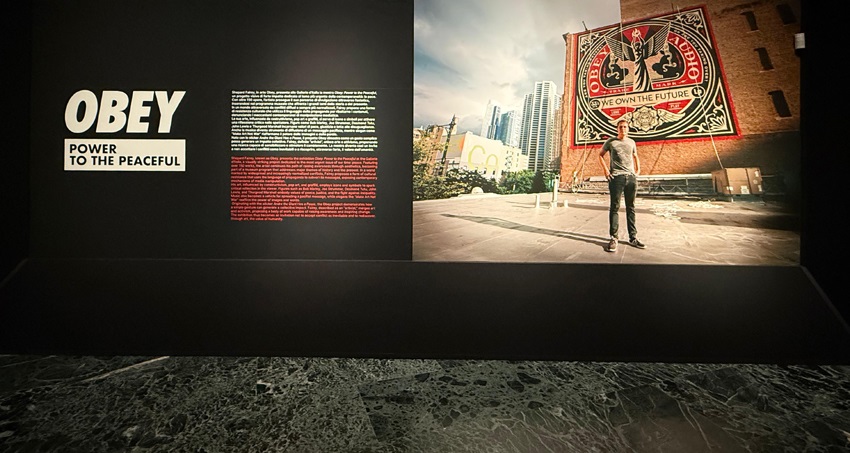
Galleries of Italy: Naples / In the darkness of the borders, the light of art. The visual resistance of Obey (Shepard Fairey)
“Through my art, I want to remind people of the equality of all human beings, regardless of race, religion, nationality, or culture. There is no ‘us’ versus them; there is only ‘us’.”
Shepard Fairey
Up until the 6th of September, the exhibition ‘OBEY: Power to the Peaceful’ is on display at the Gallerie d’Italia in Naples. It features over 150 works by Shepard Fairey, known internationally as Obey, one of the most influential artists on the contemporary urban scene. Carmine Negro guides us through this expository journey with a thoughtful analysis divided into two parts.
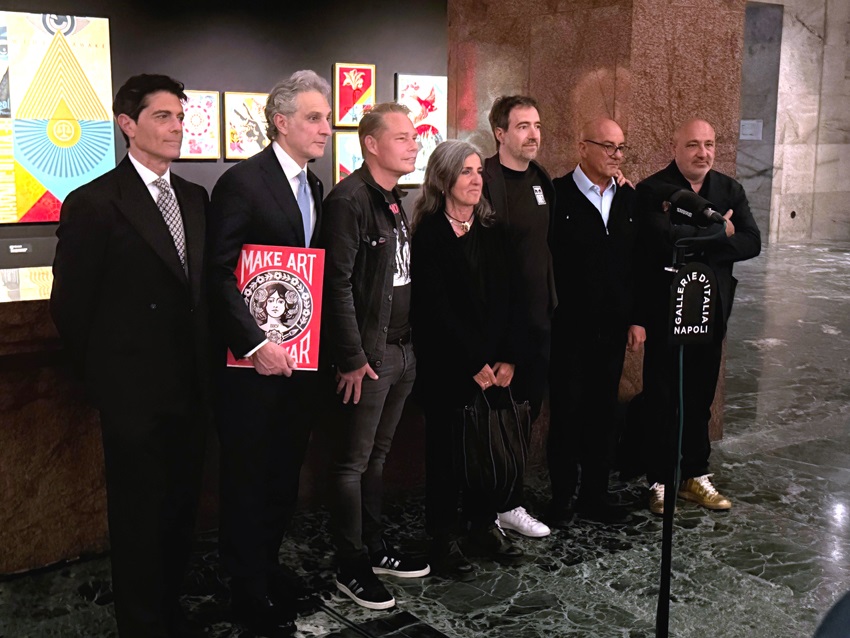
When borders harden and the lines of power become walls, art can still open breaches.
At the Gallerie d’Italia in Naples, the works of Shepard Fairey — the face behind Obey — emerge like luminous fractures within the landscape of the present: images born in the street that, once inside the museum, do not lose their urgency but rather amplify it. Their voice, made of sharp symbols and burning contrasts, does not merely ask to be seen: it cuts through, questions, and unsettles.
A language that seduces and then disturbs
Fairey’s art originates as a public gesture, as a direct intervention within urban space. Posters, repeated icons, and inverted slogans build a visual lexicon that first seduces the eye and then compels it to question itself. His aesthetic, nourished by the codes of twentieth-century propaganda, does not reproduce power: it dismantles it from within, transforming what once served as an instrument of control into a vehicle of resistance.
Within the halls of the Gallerie d’Italia, this language is not neutralized. On the contrary, the museum setting amplifies its critical force, offering viewers a broader space in which to question the role of images in shaping both consensus and dissent.
The border as a place of tension
The theme of the border runs throughout the entire exhibition: geographical, political, and cultural borders, but also less visible thresholds — between art and communication, between the street and the institution, between aesthetics and activism. Fairey works precisely along these lines of friction, transforming them into surfaces of tension. Every artwork becomes a passageway: a point where the visible cracks open, allowing a glimpse of what normally remains outside the frame.
Naples, a key to interpretation
In this dialogue, Naples is not a mere backdrop, but a lens that amplifies the meaning of the exhibition. A city born almost three thousand years ago from the encounter of different peoples — Greeks, Phoenicians, Italic populations, and other Mediterranean communities, as confirmed by anthropological studies[1] — Naples carries within its DNA a natural resistance to rigid borders, whether geographical or cultural. It is a hybrid city by origin and vocation, accustomed to transforming limits into passages and otherness into coexistence.
Shepard Fairey’s path intersects with that of Naples precisely on this terrain. Both inhabit the present through an idea of community that is open and irreducible, capable of welcoming without dissolving itself. It is no coincidence that Goethe sensed the same intensity in his famous phrase See Naples and die: not merely an aesthetic experience, but an existential one, an experience that overwhelms and restores a sense of fullness.
The social promiscuity that characterizes the city — portrayed like no other by Eduardo De Filippo — also makes Naples naturally akin to Fairey’s political imagination. Here, social classes do not live apart, but brush against one another, mingle, and observe each other. Being prevails over appearing, and the image is never merely surface, but relationship. For this reason, at the Gallerie d’Italia, the transition from street to museum does not appear as a subtraction, but rather as an expansion of the discourse: Fairey’s urban art is not domesticated, but instead finds a new space from which to interpret the city and, through it, a different way of looking at the world.
A reflection on the present
The light evoked in the title is not a promise of salvation. It is a critical light, illuminating the darkness of borders in order to make it readable, exposing its fractures and responsibilities. The exhibition does not merely present a body of works, but proposes a reflection on our visual present, entrusting viewers with the task of questioning the power of images and the role of art in contemporary public space.
The exhibition in the Salone Toledo
The space hosting the exhibition becomes an integral part of it. The Salone Toledo, in the heart of the city, reaffirms the direct bond between the museum and the urban fabric. In this vision, the museum is not a separate enclosure, but an active part of the community: it does not impose consensus, but invites critical vision. Looking thus becomes a form of participation.
Reinforcing this openness, Michele Coppola, Executive Director of Art, Culture and Historical Heritage at Intesa Sanpaolo, recalled the decision to extend free admission to visitors aged 18 to 25, enabling younger generations to experience the museum without barriers or obstacles.
Alongside the museum route, the exhibition extends into urban space itself: from the large mural in Ponticelli to the intervention on the staircase of Donnaregina Nuova, up to the donation of a work intended for the Holy Father. Each gesture opens a symbolic passage between center and periphery, between art and spirituality, between public space and individual responsibility. Those who move through these museum spaces are captivated by the vital force of Naples and contribute to contaminating the city in turn, leaving behind traces of their own art and thought.
The birth of a global icon
Before the name Obey became a global icon, everything began with a minimal gesture: a sticker. In the late 1980s, Shepard Fairey began clandestinely spreading the image of the imposing face of André the Giant, accompanied by the phrase Andre the Giant Has a Posse.
Born as a visual and social experiment, the project relied on an image devoid of any explicit message, obsessively repeated throughout the interstices of the city — walls, street signs, mailboxes — until it became both familiar and unsettling. Precisely because it appeared “meaningless,” the image forced those who encountered it to question its significance.
Shortly afterward, a single word appeared: OBEY. The term refers to John Carpenter’s film They Live, in which the protagonist, thanks to special glasses, discovers hidden messages within advertising and mass media: imperative commands such as OBEY, CONSUME, CONFORM. Fairey does not use this command in order to impose obedience, but to create a short circuit: an invitation to doubt.
Obey Giant is neither a signature nor a brand, but a critical device. Fairey appropriates the codes of propaganda in order to expose them from within, pushing viewers to ask themselves why we obey, what we obey, and to which images we entrust our gaze.
From a simple underground sticker, Obey Giant became one of the most influential phenomena in contemporary street art, marking the decisive transition toward a self-aware visual language capable of inhabiting power in order to challenge it. From here begins the path that will continue in the next article: Fairey’s urban art, transformed into Obey, no longer merely occupies urban space, but starts telling stories, constructing symbolic images, and openly engaging with the political and media spheres.
When images train obedience, what are we truly obeying while we look?
FOOTNOTE
[1] The study, published in iScience in 2025, revealed the profoundly cosmopolitan nature of the community of Pithekoussai, the ancient Euboean settlement founded on the island of Ischia in the 8th century BCE and at the origins of Parthenope. Strontium isotope analysis — a technique that determines the geographical origin of individuals through the composition of their teeth and bones — revealed the presence of people originating from distant regions: Euboea, Phoenicia, inland Campania, and other Mediterranean areas. Carmine Negro, History Teaches Us: Migration Must Be Governed, Not Fought. From Pithekoussai to Modern Society: The Strength of Diversity, Rassegna d’Ischia, 2/2026, pp. 31–33.